Prompting Is Not Engineering: Building Reliable LLM Production Systems with Control Layers
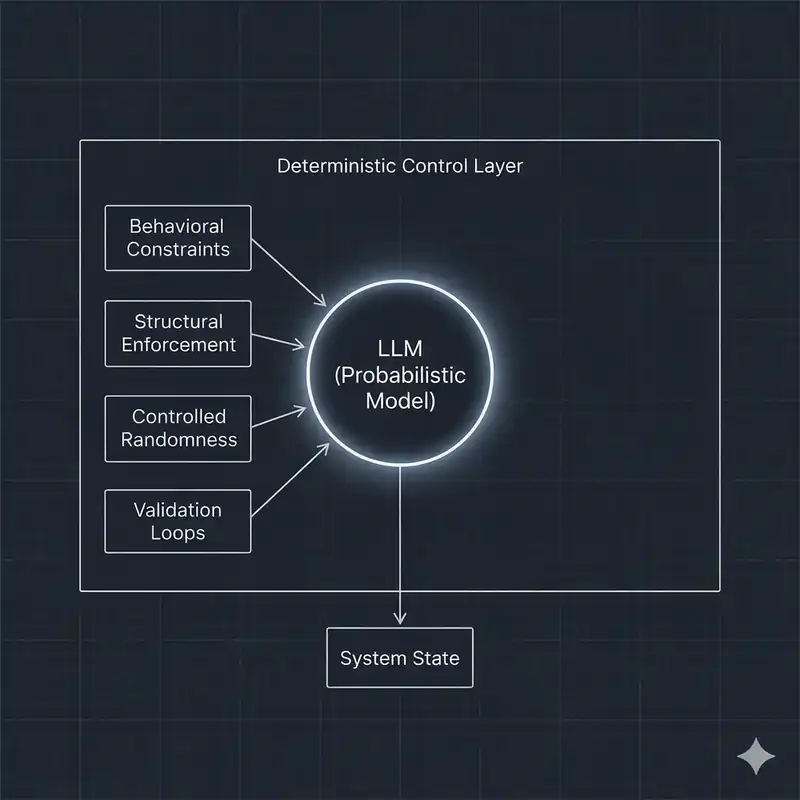
When AI outputs become unstable, most teams try to fix the prompt.
They add more instructions.
More examples.
More rules.
Sometimes it works.
But after some time, the model becomes inconsistent again.
While learning about production AI systems, I started realizing something:
Prompts guide the model.
Systems control the outcome.
AI reliability is not just about writing better prompts.
It depends on how the entire system is designed around the model.
The Four Layers That Make LLM Systems Reliable
In production, stable AI systems usually rely on four control layers:
- Behavioral Constraints
- Structural Contracts
- Controlled Randomness
- Validation Loops
These are not prompt tricks.
They are system-level safeguards around a probabilistic model.
Let’s break them down.
1. Behavioral Constraints
Limit What the Model Is Allowed to Do
The more open your instruction, the more unpredictable the output.
Instead of saying:
Generate a customer response.
A production system might define:
- Do not invent facts
- Do not offer discounts
- Do not speculate
- Keep the response under 120 words
Clear boundaries reduce hallucinations.
Without constraints, you’re relying purely on probability.
2. Structural Contracts
Make Output Safe for Your Backend
LLMs generate text.
Your systems expect structure.
If your application depends on model output, enforce a schema.
Example structure:
decision: approve | reject
confidence_score: float
reason: string
If the response doesn’t match this format, reject it.
No valid structure → no state change.
If you allow unvalidated output to update your database, you’re letting randomness modify your system.
3. Controlled Randomness
Adjust Randomness Based on Task Risk
LLMs don’t always generate the same output.
That’s how they work.
The temperature setting controls how random the response is.
Low temperature:
- More predictable
- Less variation
High temperature:
- More creative
- More variation
Not every task should use the same level of randomness.
For example:
Brainstorming ideas → higher randomness
Fraud detection → low randomness
Invoice parsing → low randomness
Code generation → low randomness
Using high randomness for high-risk tasks increases errors, retries, and cost.
Randomness is not just about creativity.
It affects reliability.
4. Validation Loops
Never Trust a Single Response
In demos, we generate once and accept the result.
In production, systems usually work in stages:
Generate
Validate
Fix if needed
Then commit
Validation may include:
- Required field checks
- Schema validation
- Number consistency checks
- Regeneration if rules fail
One-shot prompting works for demos.
Production systems need feedback loops.
The Systems Perspective
When AI fails in production, the root cause is rarely the model.
But many failures come from missing system controls:
- No schema validation
- No retry monitoring
- No randomness control
- No boundary checks
Prompts shape language.
Systems create reliability.
Where This Is Heading
Models are improving quickly.
But randomness doesn’t disappear.
The real advantage may shift toward teams that:
- Track retry rates
- Monitor cost per request
- Enforce structured outputs
- Measure first-pass success
Access to powerful models is becoming easier.
Designing safe and reliable systems around them is harder.
A Simple Question
Are we only improving prompts?
Or are we designing systems that can safely handle probability?
That difference may define the next stage of AI engineering.